
Four Forces still holding up U.S. Tech
20 sept 2026
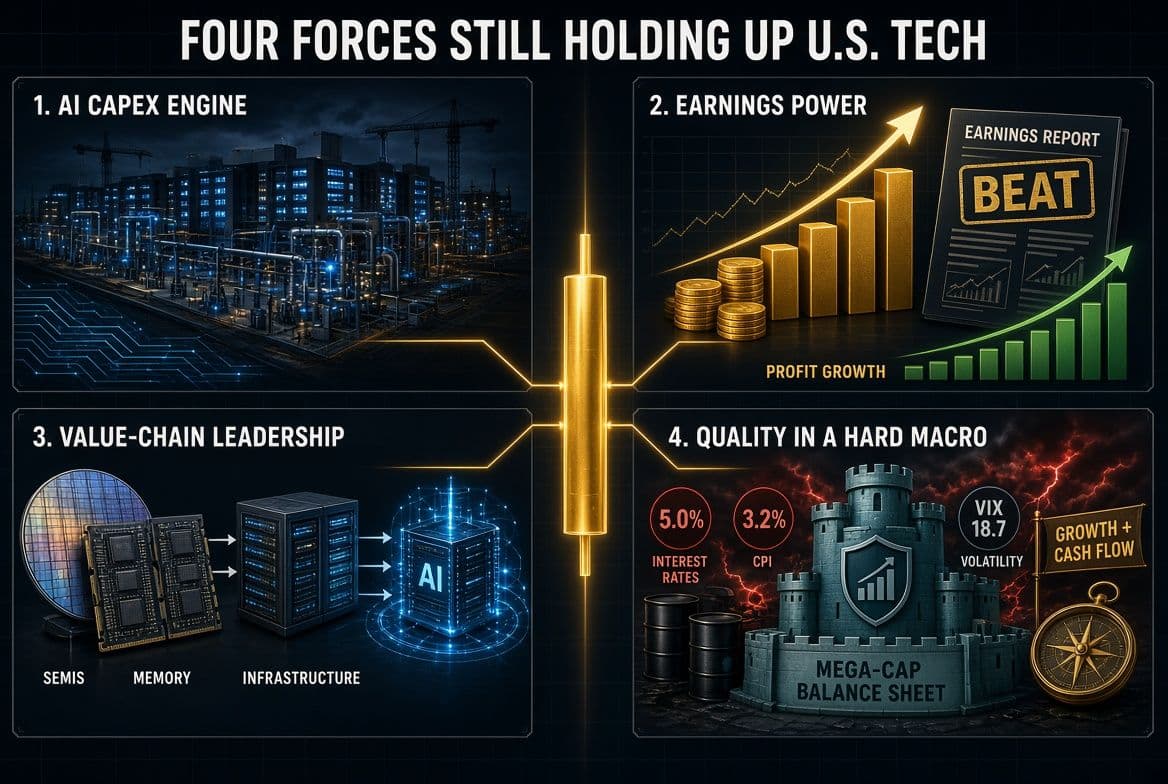
U.S. tech markets keep holding up because four forces are still working at the same time. Macro uncertainty is real. Yields are high. The Fed is no longer a tailwind. None of that has been enough to break the tape, because the market is not pricing “risk-off.” It is pricing earnings power, AI capex, and balance-sheet quality.
First, AI is no longer just a narrative. It is a growth engine inside the real economy
Spending on data centers, chips, memory, networking, power and software has become one of the clearest supports for U.S. activity. That capex is offsetting weaker parts of business investment. In other words, the same sector the market is buying is also helping the economy absorb higher rates, geopolitics and stickier inflation. Tech is not only a stock-market theme. It is part of why U.S. growth has stayed more resilient than the headline uncertainty suggests.
Second, the earnings are doing the heavy lifting
This rally is not running on hope alone. Tech profits have grown much faster than the rest of the market, and index-level earnings estimates have been revised higher through the year. When companies keep beating and raising, valuations look less stretched than the price action implies. Higher yields can coexist with higher equity prices if the rise in rates is being matched by a rise in expected cash flows. That is the core reason the Nasdaq has been able to climb a wall of worry: the worry is macro, the support is micro.
Third, leadership inside tech has broadened down the value chain
The market is no longer relying on one tight Magnificent 7 trade. A large part of 2026 strength has come from the “picks and shovels” of the AI buildout: semiconductors, memory, storage and equipment. Hyperscalers are spending hundreds of billions. The suppliers capturing that spend have often led more cleanly than the platforms writing the checks. That rotation matters. It keeps the tech complex alive even when some mega-caps stall under the weight of capex, regulation or questions about near-term ROI.
Fourth, in a world of slower growth and higher-for-longer rates, capital prefers companies that can still compound
When the outlook shifts from easy cuts and a perfect soft landing to stickier inflation and a more hawkish Fed, investors rotate toward secular growth with pricing power, high returns on equity and visible demand. Large-cap tech and the AI infrastructure complex fit that brief better than cyclical value, fragile small caps or most of Europe. The market is not saying the macro is fine. It is saying that if growth is going to be uneven, it wants the businesses most able to grow through that unevenness.
Put together, these four vectors explain the apparent contradiction. Rates, oil, geopolitics and policy uncertainty should have capped risk assets. Instead, tech has kept its bid because AI capex is supporting growth, earnings are confirming the spend, leadership has spread beyond a handful of mega-caps, and quality growth remains the default destination when the rest of the opportunity set looks weaker.
That does not make the trade risk-free. If the return on AI investment disappoints, if funding costs rise enough to choke the capex cycle, or if earnings revisions roll over, the same four supports can reverse quickly. Until then, the market is treating U.S. tech as the cleanest way to own the only supercycle still visible in an otherwise messy macro tape.