
S&P 500 Concentration: Extreme Discrepancy Between the Largest and Smallest Companies
11 oct 2026
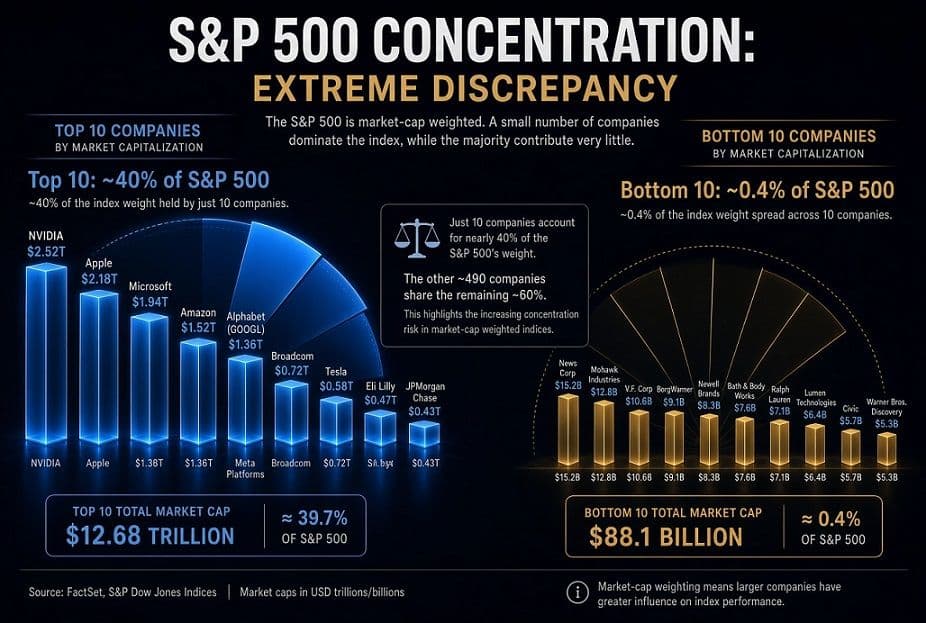
In the S&P 500, the 10 largest companies currently account for roughly 39-42% of the entire index. NVIDIA alone represents around 8%, Apple about 7%, and Microsoft roughly 5.5-6%. Together with Amazon, Alphabet (Google), Meta, Broadcom, Tesla, Micron, and Berkshire Hathaway or Eli Lilly, these names dominate the index’s weight. In contrast, the 10 smallest companies in the S&P 500 typically have market capitalizations in the low tens of billions of dollars and each carry a weight of only about 0.02–0.06%. Combined, the bottom 10 usually represent less than half a percent of the index.
This enormous gap exists because the S&P 500 is a market-capitalization-weighted index. A company’s influence on the index is directly proportional to its total market value, not equal across all constituents. Over the past decade, a small group of technology and AI-related companies has grown far faster than the rest of the market. Their exceptional earnings growth, scalability, and high valuations have caused their weights to expand dramatically. At the same time, passive investment flows into S&P 500 ETFs and index funds have further reinforced this concentration, as money automatically flows in greater proportion to the largest names.
Historically, the top 10 have averaged closer to 20-25% of the index. The current level of concentration is among the highest seen in decades. While this structure accurately reflects where market value currently sits, it also means the performance of the “500” is heavily driven by a handful of companies.
This situation is especially bad in the major U.S. indices, and even worse in the IWM (Russell 2000) small-cap index. Liquidity is now concentrated in the 10 largest companies, leaving the rest of the market and especially small caps with very little liquidity.