
Small-Cap Sensitivity to Rising Yields and Their Recent Underperformance
27 oct 2026
Small-Cap Sensitivity to Rising Yields and Their Recent Underperformance
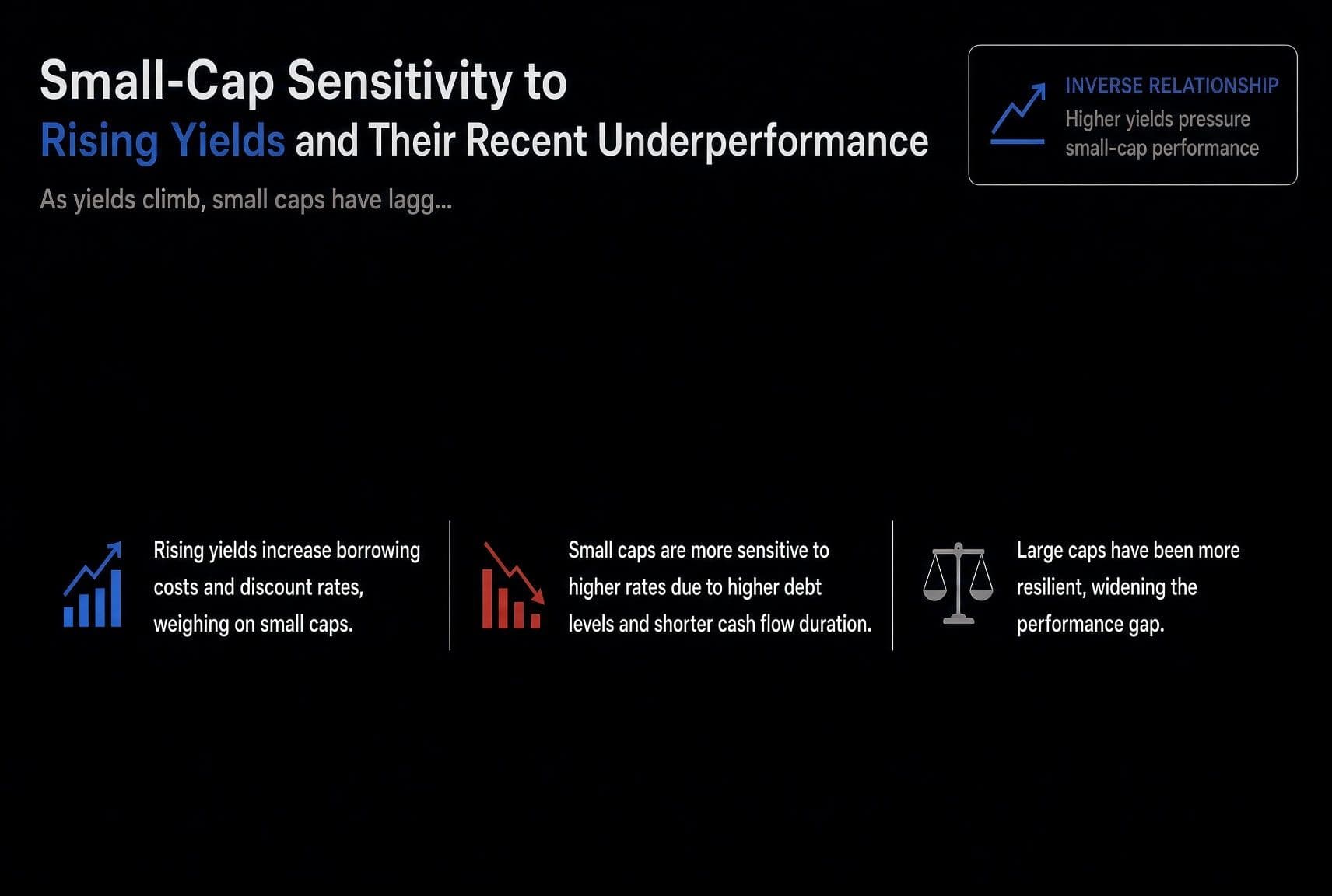
Small-cap companies have shown particularly high sensitivity to rising bond yields, which explains much of their weak performance in recent months relative to the major U.S. technology giants.
Unlike mega-cap technology companies, which generally have strong balance sheets, substantial free cash flow generation, and the ability to finance themselves at relatively low cost, small-caps typically have more fragile capital structures. On average, they carry higher levels of debt, a larger share of floating-rate debt, and shorter debt maturities. Roughly 30% of small-cap debt is estimated to be floating-rate, compared with only about 8% for large-caps. When yields rise, the cost of servicing debt increases almost immediately, squeezing margins and reducing the capacity to invest and grow.
In addition, many of these companies have lower credit ratings and rely more heavily on external financing to expand their operations. In a high-yield environment (such as the current one, with the 10-year Treasury near or above 5%), refinancing becomes more expensive and difficult, raising the risk of financial stress. This effect is amplified by the fact that the Russell 2000 includes a significant portion of companies that are still unprofitable or operate with thin margins.
From a valuation perspective, higher interest rates increase the discount rate applied to future cash flows. Because many small-caps are growth-oriented companies whose cash flows are more back-loaded, their valuations are disproportionately affected.
This dynamic has been clearly visible in 2026. After a strong start to the year in which small-caps significantly outperformed large-caps, the persistent rise in yields from the summer onward reversed the trend. The Russell 2000 recorded notable declines during periods of rising rates, while the Nasdaq-100 and large technology stocks remained relatively resilient, supported by market concentration in high-quality names with strong cash generation. Analysts have identified the rise in yields as the main driver of the recent divergence, with a clear negative correlation between changes in long-term bond yields and small-cap performance.
In short, rising yields act as a heavier cost of capital for small companies both through higher interest expenses and through the discounting effect on valuations. While the technology giants can absorb or even benefit from this environment thanks to their financial strength, small-caps are more exposed, which accounts for their relatively weak performance in recent months.